

Dubai Metro Guide: Metro Timings, Metro Tickets and Lines
Dubai is a city where time matters. Millions of people travel daily from residential neighbourhoods to offices spread across financial districts, business corridors, industrial zones, and older commercial areas. As the city expanded, relying only on private cars became unsustainable. This is where the Dubai Metro, supported by the Metro Feeder Bus network, became one of the most important pillars of urban life.
This guide is written for working professionals—whether you are employed in a corporate office, a small agency, a trading firm, a government department, or a service-sector business. The goal is simple:
after reading this guide, you should clearly know which metro line to take, where to change, and how to reach your office efficiently.
The History of Dubai Metro: Why It Was Built
In the early 2000s, Dubai experienced rapid population growth and economic expansion. New business districts emerged along Sheikh Zayed Road, while older commercial centres in Deira and Bur Dubai remained active. Traffic congestion increased sharply, and daily commuting times began to affect productivity and quality of life.
To address this, Dubai launched one of the most ambitious public transport projects in the region—the Dubai Metro.
Construction began in 2006, with a vision to create a fully automated, driverless rail system that could move large numbers of people safely and efficiently. Advanced technology was used to ensure reliability, punctuality, and passenger comfort.
Major Milestones
- 2006 – Construction of Red and Green Lines began
- 9 September 2009 – Red Line officially opened
- 2011 – Green Line launched, serving Deira and Bur Dubai
- 2021 – Extension opened to Expo 2020 (now Expo City Dubai)
- 2023 – Blue Line announced as the next phase of expansion
Today, the Dubai Metro is operated by the Roads and Transport Authority (RTA) and is recognised as one of the longest driverless metro systems in the world.
Understanding the Dubai Metro System as a Whole
One common mistake new commuters make is thinking of the metro as “just a train.” In reality, Dubai Metro works as a complete transport system that includes:
- Metro trains for long-distance movement across the city
- Metro feeder buses for reaching offices and neighbourhoods away from main roads
- Interchange stations that allow easy switching between lines
This integrated design is what makes it possible to commute daily without owning a car—even when offices are located deep inside business districts or residential communities.
Dubai Metro Lines Explained
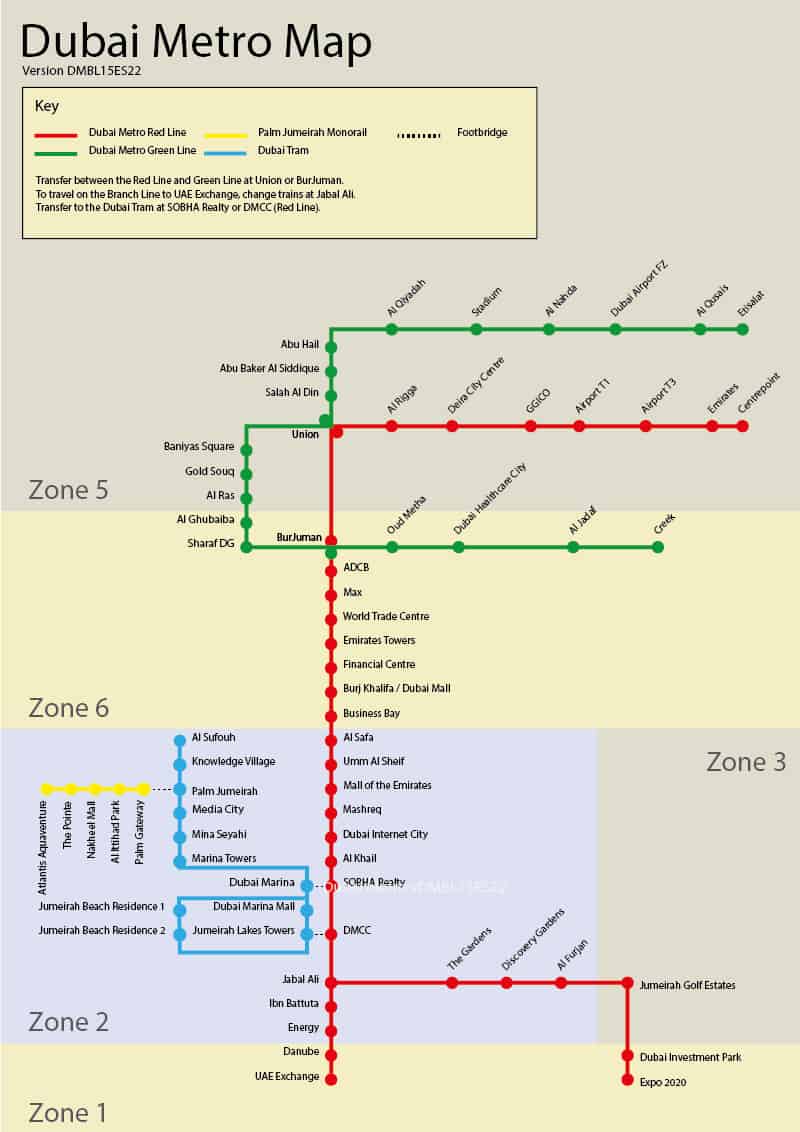
Red Line: The Main Business Corridor
The Red Line runs parallel to Sheikh Zayed Road, Dubai’s primary commercial artery. It connects the city’s most prominent business districts and modern office hubs.
This line is commonly used by professionals working in:
- Corporate headquarters
- Consulting and professional service firms
- Technology and digital companies
- Media and creative offices
- Free zones and industrial areas
If your office is anywhere near Sheikh Zayed Road or in newer parts of Dubai, the Red Line is usually your starting point.
Green Line: Old Dubai and Central Commercial Areas
The Green Line serves Deira, Bur Dubai, and surrounding neighbourhoods. These areas include older commercial centres, government offices, clinics, and trading businesses.
This line is particularly useful for:
- Employees in trading and wholesale businesses
- Government and semi-government offices
- Service-sector workplaces
- Smaller agencies and independent professionals
Interchange Stations: Where Lines Meet
There are two critical interchange stations in the Dubai Metro system:
- Union Station – connects Red and Green Lines
- BurJuman Station – connects Red and Green Lines
Most commuters who travel between Old Dubai and New Dubai will pass through one of these stations.
Dubai Metro Timings: What Office Workers Should Know
Standard Operating Hours
| Day | First Train | Last Train |
|---|---|---|
| Monday–Thursday | 05:00 AM | 12:00 AM |
| Friday | 05:00 AM | 01:00 AM |
| Saturday | 05:00 AM | 12:00 AM |
| Sunday | 08:00 AM | 12:00 AM |
Important notes:
- First and last train times vary slightly by station
- Peak hours (morning and evening) have more frequent trains
- Public holidays may have special schedules
Feeder Bus Frequency
- Peak hours: every 10–15 minutes
- Off-peak hours: every 20–30 minutes
Major Office & Business Areas in Dubai and How to Reach Them
Dubai Internet City
Type: Technology companies, software firms, digital businesses, startups, and creative offices
Best Line: Red Line
Nearest Station: Dubai Internet City
Many professionals working in digital and technology roles commute daily to this area using the Red Line, followed by a short walk or local bus connection.
Dubai Media City
Type: Media companies, content studios, creative agencies, and broadcasting offices
Best Line: Red Line
Nearest Station: Dubai Internet City
Media City shares strong connectivity with Internet City, making it easily accessible without a car.
Business Bay
Type: Corporate offices, consulting firms, professional service companies, and mixed-use business towers
Best Line: Red Line
Nearest Station: Business Bay
Due to the size of Business Bay, many offices require a short feeder bus ride or walk from the station.
Downtown Dubai
Type: Corporate offices, commercial towers, premium businesses, and service companies
Best Line: Red Line
Nearest Station: Burj Khalifa/Dubai Mall
Downtown is walkable in parts, but feeder buses help during peak heat or long distances.
DIFC (Dubai International Financial Centre)
Type: Financial institutions, consulting firms, corporate offices, and professional services
Best Line: Red Line
Nearest Stations: Financial Centre, Emirates Towers
DIFC is one of the most metro-friendly office districts in Dubai.
JLT (Jumeirah Lake Towers)
Type: SME offices, consulting firms, small agencies, and independent professionals
Best Line: Red Line
Nearest Station: DMCC
Most clusters are walkable from the station.
Al Quoz
Type: Creative studios, workshops, service companies, and small offices
Best Line: Red Line
Nearest Stations: Onpassive, Equiti
Feeder buses are often used for last-mile access.
Deira & Bur Dubai
Type: Trading offices, small web agencies, SEO freelancers, government departments, and service-sector businesses
Best Line: Green Line
Nearest Stations: Union, Salah Al Din, Baniyas Square, Al Ghubaiba
These areas remain some of the busiest commercial zones in the city.
Dubai Metro Red Line Stations
R11 – Centrepoint
R12 – Emirates
R13 – Airport Terminal 3
R14 – Airport Terminal 1
R15 – GGICO
R16 – City Centre Deira
R17 – Al Rigga
R18 – Union
R19 – BurJuman
R20 – ADCB
R21 – Max
R22 – World Trade Centre
R23 – Emirates Towers
R24 – Financial Centre
R25 – Burj Khalifa/Dubai Mall
R26 – Business Bay
R29 – Onpassive
R31 – Equiti
R32 – Mall of the Emirates
R33 – Mashreq
R34 – Dubai Internet City
R35 – Al Khail
R36 – Sobha Realty
R37 – DMCC
R38 – Jebell Ali
R39 – Ibn Battuta
R40 – Energy
R41 – Danube
R42 – UAE Exchange
R70 – The Gardens
R71 – Discovery Gardens
R72 – Al Furjan
R73 – Jumeirah Golf Estates
R74 – Dubai Investment Park
R76 – Expo 2020
Dubai Metro Green Line Stations
G11 – Etisalat by e&
G12 – Al Qusais
G13 – Dubai Airport Free Zone
G14 – Al Nahda
G15 – Stadium
G16 – Al Qiyadah
G17 – Abu Hail
G18 – Abu Baker Al Siddique
G19 – Salah Al Din
G20 – Union
G21 – Baniyas Square
G22 – Gold Souq
G23 – Al Ras
G24 – Al Ghubaiba
G25 – Sharaf DG
G26 – BurJuman
G27 – Oud Metha
G28 – Dubai Healthcare City
G29 – Al Jadaf
G30 – Creek
Metro Feeder Bus System: Last-Mile Connectivity
Metro feeder buses exist because metro trains cannot enter residential streets or industrial zones. These buses connect stations to nearby communities and office clusters.
Key Points for Daily Commuters
- Route codes start with F
- Operate from metro or nearby bus stations
- Use the same Nol card as the metro
- Serve areas, not individual buildings
For many professionals, feeder buses are what make metro commuting practical.
Nol Card: Essential for Office Commuters
The Nol card is Dubai’s unified payment system for public transport. It works on:
- Metro
- Feeder buses
- Public buses
- Tram and marine transport
Types of Nol Cards
- Silver Nol Card: Best for daily commuters
- Gold Nol Card: Access to premium metro cabins
- Blue Nol Card: Personalised, special categories
- Red Ticket: Limited use, not ideal for office workers
Fares (Approximate)
- 1 zone: AED 3
- 2 zones: AED 5
- 3+ zones: AED 7.5
Monthly and long-term passes are cost-effective for regular office travel.
How to Plan Your Daily Office Commute
- Identify your office area
- Choose the correct metro line
- Find the nearest station
- Use Union or BurJuman if switching lines
- Use feeder buses or walk for the last mile
Final Thoughts
Dubai Metro, supported by the Metro Feeder Bus network, offers a reliable, affordable, and efficient commuting solution for professionals across the city. Whether you work in a large corporate office, a small agency, a trading firm, or a service-sector business, the system is designed to get you to work without the stress of driving.

Optimize Your Site Today – Get Expert SEO Services Now!
About Client
Similar articles
View all-

SEO Marketing (2026 Guide): Definition, Importa...
Last updated: December 22, 2025 SEO marketing has evolved from a tactical discipline into a core business growth channel. In 2026, search engine optimization is no longer limited to ranking...
SEO Marketing (2026 Guide): Definition, Importa...
Last updated: December 22, 2025 SEO marketing has evolved from a tactical discipline into a core business growth channel. In 2026, search engine optimization is no longer limited to ranking...
-

Top SEO Agencies in Dubai
Top SEO agencies in Dubai are hired when businesses need reliable, compounding organic growth in a market where competition is intense, customer expectations are high, and buying journeys are...
Top SEO Agencies in Dubai
Top SEO agencies in Dubai are hired when businesses need reliable, compounding organic growth in a market where competition is intense, customer expectations are high, and buying journeys are...
-

5 Best Shopify Stores in Dubai, UAE
Every successful Shopify store has one thing in common: a strong foundation built on strategy, design, performance, and user experience. At Team Rhino Marketing Consultants, we’ve spent years designing and developing...
5 Best Shopify Stores in Dubai, UAE
Every successful Shopify store has one thing in common: a strong foundation built on strategy, design, performance, and user experience. At Team Rhino Marketing Consultants, we’ve spent years designing and developing...


- Choosing a selection results in a full page refresh.
- Opens in a new window.